
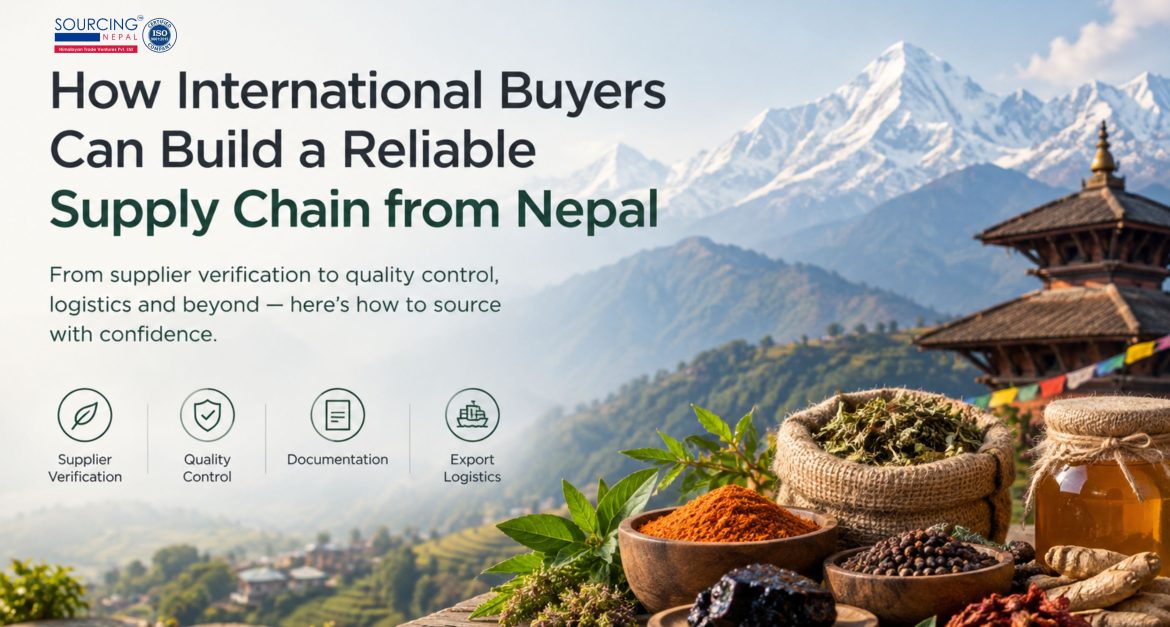
How International Buyers Can Build a Reliable Supply Chain from Nepal
Nepal is becoming an increasingly interesting sourcing destination for international buyers looking for distinctive natural products, Himalayan ingredients, handmade goods, herbs, spices, essential oils, and specialty products. The country offers access to products that are difficult to find elsewhere, often with strong regional identities and traditional production methods.
However, sourcing from Nepal requires more than simply finding a supplier and placing an order.
International buyers need to consider supplier reliability, product consistency, quality testing, documentation, packaging, logistics, and communication throughout the procurement process. Because Nepal’s supplier market can be fragmented and its export infrastructure has unique challenges, having a structured sourcing process can significantly reduce risk.
So, how can international buyers build a reliable supply chain from Nepal?
Why Consider Sourcing from Nepal?
Nepal’s geographic diversity creates access to a wide range of agricultural, botanical, Himalayan, and handmade products.
Depending on the region and altitude, buyers can source products such as:
- Himalayan herbs and botanicals
- Spices and dried agricultural products
- Essential oils
- Specialty coffee
- Himalayan honey
- Shilajit and other Himalayan products
- Handmade paper and Lokta products
- Felt and handmade products
- Natural ingredients for food, wellness, and personal-care products
For international brands, Nepal can offer more than another supply option. It can provide access to products with a strong origin story and distinctive characteristics.
The challenge is turning that potential into a consistent and dependable supply chain.
1. Start by Clearly Defining Your Product Requirements
A reliable sourcing process starts with a clear product specification.
Before contacting suppliers, international buyers should define as many requirements as possible, including:
- Product name and botanical or technical specifications
- Origin or preferred sourcing region
- Grade and quality requirements
- Processing method
- Moisture or purity requirements
- Desired packaging
- Required certifications or laboratory testing
- Target quantity
- Minimum and maximum order volumes
- Private-label or OEM requirements
- Destination country
- Required delivery timeline
For natural products, specifications may need to go even further.
For example, a buyer sourcing specialty coffee may need information about altitude, variety, processing protocol, fermentation, drying method, and cup profile. A buyer sourcing botanical ingredients may require botanical identification, part used, processing method, heavy-metal testing, microbiological testing, or pesticide-residue analysis.
The clearer the specification, the easier it becomes to compare suppliers objectively.
2. Find Suppliers Beyond Basic Online Searches
Finding a supplier is relatively easy. Finding the right supplier is much harder.
International buyers can discover Nepali suppliers through manufacturers, cooperatives, farmer groups, processors, exporters, industry networks, trade associations, and sourcing companies.
However, supplier discovery should not be treated as the final step.
A supplier may appear suitable online but still lack the production capacity, documentation, quality systems, or export experience required by an international buyer.
This is why supplier screening is essential before moving to commercial negotiations.
3. Verify the Supplier Before Placing an Order
Supplier verification is one of the most important stages when sourcing from Nepal.
Before committing to a supplier, buyers should evaluate:
Business legitimacy
Check whether the supplier is an established business and whether its business registration and export-related documentation are available where applicable.
Production capability
Understand whether the supplier actually manufactures or processes the product or is acting as a trader.
Capacity
Ask whether the supplier can consistently meet your required quantity—not just produce a successful sample.
Quality systems
Understand how raw materials are selected, processed, stored, tested, and packed.
Previous export experience
Experience with international buyers can indicate whether the supplier understands export documentation, packaging requirements, and international communication.
Product traceability
For agricultural and botanical products, knowing where the raw material originates can be particularly important.
A structured supplier assessment can help buyers compare potential partners instead of making decisions based only on price.
4. Always Evaluate Samples Before Bulk Orders
A sample is not simply a demonstration of what a supplier can make. It is an opportunity to establish the expected commercial specification.
International buyers should evaluate samples against clearly defined criteria.
Depending on the product, this may include:
- Appearance
- Aroma
- Taste
- Texture
- Color
- Purity
- Moisture
- Particle size
- Processing characteristics
- Packaging quality
- Laboratory results
For natural products, some variation can occur between harvests, regions, or batches. Therefore, buyers should discuss acceptable variation with the supplier before placing a large order.
It is also useful to document the approved sample or reference specification so that future production can be compared against an agreed standard.
5. Build Quality Control Into the Supply Chain
Quality control should not begin when the shipment is ready.
It should be integrated throughout the sourcing process.
A practical quality-control system can include:
Raw material verification → Processing monitoring → Laboratory testing → Sample approval → Production inspection → Pre-shipment inspection
The exact process depends on the product.
For food, herbs, spices, and botanical ingredients, laboratory testing may be appropriate for parameters such as microbiology, heavy metals, pesticide residues, moisture, or other product-specific requirements.
For manufactured goods, inspections may focus on dimensions, materials, workmanship, packaging, labeling, and quantity.
The goal is simple: identify problems before the shipment leaves Nepal.
This can be significantly less expensive than discovering a quality issue after the goods have reached the destination country.
6. Don’t Make Price the Only Supplier Selection Criteria
A lower quotation does not necessarily mean a lower total sourcing cost.
International buyers should consider the full cost of procurement, including:
- Product price
- Packaging
- Testing
- Inspection
- Documentation
- Inland transportation
- Export handling
- Freight
- Customs-related costs
- Potential delays
- Rejection or replacement risk
A supplier offering the lowest initial price may become more expensive if quality problems, inconsistent production, communication gaps, or shipment delays occur.
Instead of asking only, “Who offers the lowest price?”, buyers should ask:
“Which supplier offers the best balance of quality, reliability, cost, and scalability?”
7. Understand Nepal’s Export Logistics
Nepal’s landlocked geography makes export logistics an important part of supply-chain planning.
Depending on the destination and product, goods may move through road and international transit routes before reaching the final market. This can make transportation planning, documentation, freight coordination, and delivery timelines particularly important.
Buyers should discuss logistics early rather than after production is complete.
Important questions include:
- Where will the goods be collected?
- What is the expected production lead time?
- Which export route will be used?
- Who handles export documentation?
- What is the preferred Incoterm?
- How will the shipment be inspected?
- What is the estimated transit time?
- What happens if there is a logistics delay?
8. Make Documentation Part of the Sourcing Process
Documentation requirements vary according to the product and destination market.
Depending on the shipment, buyers may need documents such as:
- Commercial invoice
- Packing list
- Certificate of origin
- Laboratory or COA reports
- Phytosanitary documentation where applicable
- Product-specific certificates
- Export documentation
- Shipping documents
Buyers should confirm requirements with their importer, customs broker, and relevant authorities in the destination market.
This is especially important for food, botanical, herbal, and wellness products because different countries can have different regulatory requirements.
A supplier who can provide a product is not necessarily a supplier who can successfully prepare an export-compliant shipment.
9. Build a Long-Term Supplier Relationship
A reliable supply chain is rarely created through a single transaction.
Once a supplier has successfully completed an order, buyers should work toward establishing a repeatable process.
This can include:
- Approved product specifications
- Agreed quality standards
- Standard packaging
- Production lead times
- Testing requirements
- Inspection procedures
- Reordering schedules
- Communication procedures
- Corrective-action processes
Long-term relationships can also make it easier to develop customized products, improve packaging, negotiate better commercial terms, and plan production in advance.
10. Work With a Local Sourcing Partner
For international buyers unfamiliar with Nepal, working directly with multiple suppliers can create additional administrative and operational challenges.
A local sourcing partner can act as the bridge between the international buyer and Nepali supply base.
A sourcing partner can help with:
Supplier discovery
Identify manufacturers, processors, farmers, cooperatives, and other potential suppliers.
Supplier verification
Assess business credibility, production capabilities, facilities, and documentation.
Sample coordination
Collect and coordinate samples according to the buyer’s specifications.
Quality control
Coordinate testing, inspections, and production checks.
Negotiation and communication
Help international buyers communicate specifications and commercial requirements clearly.
Export coordination
Support documentation, logistics coordination, and shipment preparation.
This approach allows buyers to maintain international purchasing standards while benefiting from local market knowledge.
A Practical Framework for Sourcing from Nepal
For international buyers, the process can be simplified into eight steps:
1. Define your requirements
Create a clear product specification.
2. Identify potential suppliers
Build a shortlist based on product capability and relevance.
3. Verify suppliers
Assess business legitimacy, capacity, quality systems, and export readiness.
4. Request samples
Evaluate products against your requirements.
5. Confirm quality standards
Establish testing and inspection requirements.
6. Negotiate commercial terms
Consider price, MOQ, packaging, payment terms, lead time, and Incoterms.
7. Inspect and prepare the shipment
Verify quality, quantity, packaging, and documentation before dispatch.
8. Review supplier performance
Track quality, delivery, communication, and consistency for future orders.
This structured approach turns sourcing from a one-time supplier search into a repeatable procurement process.
How Sourcing Nepal Can Help
At Sourcing Nepal, we help international buyers navigate the Nepali supply market and connect with suitable local suppliers.
Our sourcing support can cover supplier identification, supplier verification, sample coordination, product customization, quality and laboratory testing coordination, pre-shipment inspection, documentation support, and export logistics.
Whether you are looking for Himalayan ingredients, herbs and spices, essential oils, specialty coffee, handmade products, or customized products from Nepal, our role is to make the sourcing process more structured and transparent.
For international buyers, the objective is not simply to find a supplier in Nepal.
It is to build a supply chain you can rely on.
📩 Ready to import from Nepal?
Contact us today for samples, pricing, or consultation:
🔗 www.sourcingnepal.com
📧 sourcing@sourcingnepal.com
📞 +977-9823900499