
How to Build a Supplier Scorecard When Sourcing from Nepal
Sourcing from Nepal gives international buyers access to distinctive products such as Himalayan herbs, spices, essential oils, handicrafts, felt products, specialty foods, and pet products. However, finding a supplier is only the first step. The bigger challenge is determining whether that supplier can consistently meet your quality, pricing, production, and export requirements.
Many buyers compare suppliers mainly on price. This can be risky. A supplier offering the lowest quotation may have limited production capacity, inconsistent quality, weak documentation, or little experience with international orders.
A supplier scorecard provides a structured way to compare potential Nepal suppliers before committing to a purchase order.
What Is a Supplier Scorecard?
A supplier scorecard is a simple evaluation system that assigns points to different areas of supplier performance.
Instead of asking only, “Who offers the lowest price?”, buyers can evaluate suppliers based on:
- Product quality
- Production capacity
- Pricing
- Certifications and documentation
- Export experience
- Communication
- Lead time
- Packaging capabilities
- Quality control
- Reliability
This approach is particularly useful when sourcing from Nepal because suppliers can vary significantly in size, capabilities, production methods, and export experience.
1. Evaluate Product Quality First
Quality should carry significant weight in your supplier evaluation.
Before selecting a supplier, request samples and compare them against your specifications. Depending on the product, you may need to evaluate:
- Raw material quality
- Appearance and consistency
- Size and weight
- Moisture levels
- Ingredients
- Processing methods
- Packaging quality
- Product durability
- Laboratory test results
For food, herbs, botanicals, essential oils, and wellness products, additional testing may be required depending on the destination market.
A supplier that consistently delivers the required specifications is generally more valuable than one offering a slightly lower price.
2. Check Production Capacity
A supplier may produce excellent samples but struggle to fulfil a larger order.
Ask potential suppliers:
- What is your monthly production capacity?
- What is your current production volume?
- How much stock is normally available?
- Can you handle repeat orders?
- What is your normal production lead time?
- Can production be increased if demand grows?
This is particularly important for international brands planning to scale after a successful trial order.
A useful scorecard can separate sample quality from bulk-order capability so that buyers do not confuse the two.
3. Compare Pricing Beyond the Unit Cost
Price is important, but the quoted unit price is not always the final sourcing cost.
When sourcing from Nepal, buyers should consider:
Product cost + packaging + testing + inland transportation + documentation + export handling + international freight = landed sourcing cost
Ask suppliers whether their quotation includes packaging, labeling, testing, and other required services.
Comparing the complete cost gives buyers a more realistic picture of which supplier offers the best commercial value.
4. Verify Export Readiness
A supplier experienced in domestic sales may not necessarily be prepared for international exports.
Check whether the supplier can support requirements such as:
- Commercial invoices
- Packing lists
- Certificate of Origin, when applicable
- Product-specific certificates
- Laboratory reports
- Phytosanitary documentation, where required
- Export packaging
- International shipping coordination
The exact documentation depends on the product and destination country.
Export experience should therefore be a separate category in your supplier scorecard.
Review Certifications and Testing
Certifications should never be assumed simply because a supplier describes a product as “natural,” “organic,” “premium,” or “export quality.”
Ask for copies of relevant certifications and test reports.
For applicable products, buyers may need to review:
- Certificate of Analysis (COA)
- Microbiological testing
- Heavy metal testing
- Pesticide residue testing
- Organic certification
- Product-specific certifications
- Material or safety testing
If a supplier cannot provide documentation that your target market requires, this should significantly affect its score.
6. Measure Communication and Responsiveness
Communication is often underestimated when selecting suppliers.
A supplier can have competitive pricing and good products but still create problems if responses are slow or specifications are repeatedly misunderstood.
Evaluate:
- Response time
- Ability to understand specifications
- Accuracy of quotations
- Willingness to answer questions
- Professionalism
- Ability to communicate in English
- Speed of resolving issues
Good communication becomes even more important during production, quality inspection, and shipment coordination.
7. Assess Packaging and Private Label Capabilities
For brands purchasing finished products, packaging capability can be a major factor.
Ask whether the supplier can provide:
- Custom labels
- Printed packaging
- Private labeling
- Custom sizes
- Custom formulations, where applicable
- Barcodes and labeling support
- Export-ready packaging
If you need private-label products, evaluate packaging capabilities separately instead of treating them as part of general production capacity.
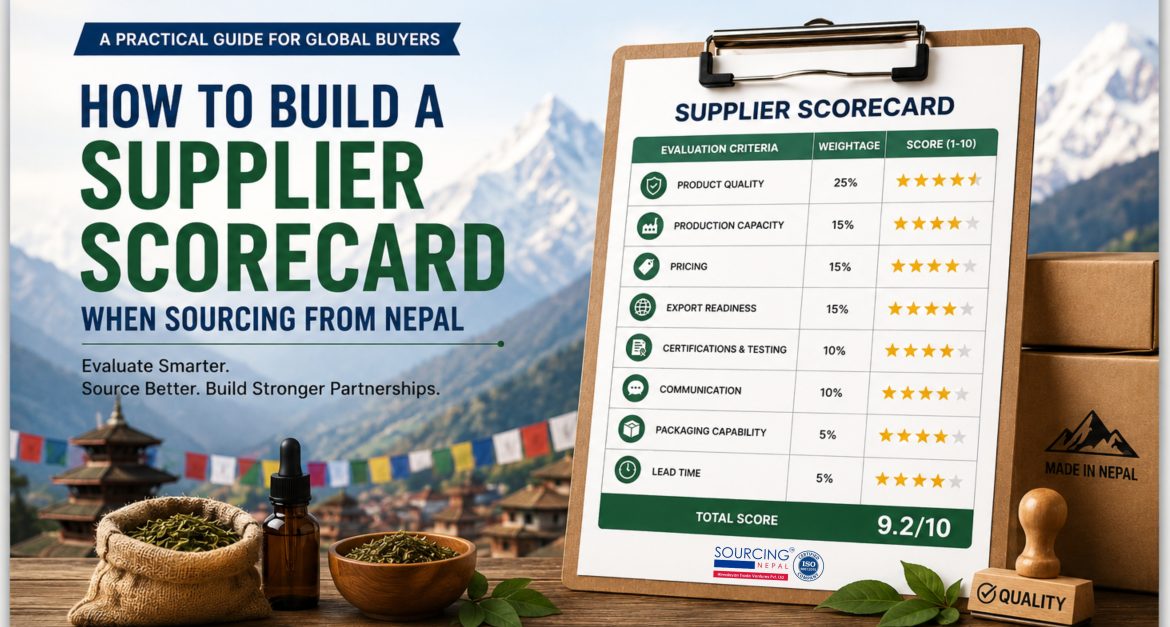
8. Create a Weighted Supplier Score
A simple scoring model can make supplier comparisons much easier.
For example:
| Evaluation Category | Weight |
|---|---|
| Product Quality | 25% |
| Production Capacity | 15% |
| Pricing | 15% |
| Export Readiness | 15% |
| Certifications & Testing | 10% |
| Communication | 10% |
| Packaging Capability | 5% |
| Lead Time | 5% |
Score every supplier from 1 to 10 in each category and multiply the score by the assigned weight.
This creates an overall supplier rating rather than relying on one factor such as price.
9. Verify Before Making the Final Decision
A supplier scorecard should support—not replace—supplier verification.
Before placing a significant order, consider conducting:
- Supplier background verification
- Business registration checks
- Factory or facility verification
- Sample evaluation
- Document verification
- Quality testing where necessary
- Pre-shipment inspection
These steps can help identify problems before they become expensive.
How Sourcing Nepal Helps International Buyers
For international businesses sourcing from Nepal, managing several suppliers can be time-consuming. Sourcing Nepal helps buyers identify and coordinate suppliers while supporting product sourcing, sample coordination, supplier verification, quality control, documentation, and export logistics.
This allows buyers to evaluate suppliers based on more than price and build sourcing relationships around quality, reliability, and long-term requirements.
For international businesses sourcing from Nepal, managing several suppliers can be time-consuming. Sourcing Nepal helps buyers identify and coordinate suppliers while supporting product sourcing, sample coordination, supplier verification, quality control, documentation, and export logistics.
This allows buyers to evaluate suppliers based on more than price and build sourcing relationships around quality, reliability, and long-term requirements.
Conclusion
Choosing the right supplier is one of the most important decisions when sourcing from Nepal. A structured supplier scorecard helps international buyers compare potential partners objectively and identify risks before placing bulk orders.
Instead of selecting a supplier simply because it offers the cheapest quotation, evaluate quality, capacity, compliance, communication, pricing, documentation, and export readiness together.
A supplier that performs consistently across these areas can provide far greater long-term value than a supplier competing only on price.
For businesses planning to source products from Nepal, a professional supplier evaluation process can make the difference between a one-time purchase and a reliable international supply chain.
📩 Ready to import from Nepal?
Contact us today for samples, pricing, or consultation:
🔗 www.sourcingnepal.com
📧 sourcing@sourcingnepal.com
📞 +977-9823900499