
How to Reduce Quality Risks When Sourcing from Nepal
Sourcing from Nepal gives international buyers access to unique products such as Himalayan herbs, spices, essential oils, handicrafts, specialty foods, tea, coffee, and pet products. However, finding an attractive product and competitive price is only the beginning.
For international buyers, one of the biggest challenges is maintaining consistent quality from the first sample to the final shipment.
Differences in raw materials, production methods, packaging, specifications, and supplier capabilities can create quality problems if they are not identified early. This is especially important when sourcing from Nepal for the first time or working with smaller manufacturers.
The good news is that most quality risks can be reduced through a structured sourcing and quality-control process.
Why Quality Control Matters When Sourcing from Nepal
Quality problems can become expensive once products have already been manufactured and shipped.
A buyer may discover issues such as:
- Inconsistent product quality
- Incorrect product specifications
- Damaged packaging
- Incorrect labeling
- Variation between samples and bulk production
- Insufficient testing
- Incorrect quantities
- Poor finishing or workmanship
Fixing these problems after shipment can be difficult and expensive.
That is why quality control should begin before production, rather than only when the goods are ready to ship.
1. Clearly Define Your Product Specifications
One of the simplest ways to reduce quality problems is to create clear product specifications before requesting quotations.
Do not rely only on product names or general descriptions.
Depending on the product, your specifications may include:
- Product dimensions
- Weight
- Ingredients
- Material
- Color
- Grade
- Moisture level
- Packaging requirements
- Labeling requirements
- Tolerance levels
- Quantity
- Testing requirements
- Country-specific compliance requirements
For example, a buyer sourcing herbal products should define the required product identity, packaging, quantity, testing requirements, and acceptable quality parameters.
The more precise the specifications, the easier it becomes for both the supplier and buyer to understand what is expected.
2. Always Request a Pre-Production Sample
A sample provides an important reference point before bulk production begins.
Instead of approving a supplier based only on photographs or descriptions, international buyers should request a physical sample whenever practical.
The sample can be used to evaluate:
- Product quality
- Materials
- Appearance
- Size
- Packaging
- Workmanship
- Taste or aroma where applicable
- Product specifications
Once approved, the sample should become the benchmark for bulk production.
This gives both parties a clear understanding of what the final product is expected to look like.
3. Verify the Supplier’s Production Capability
A supplier may be able to produce a good sample but still struggle with a larger order.
Before placing a significant purchase order, buyers should understand the supplier’s actual production capabilities.
Consider checking:
- Production capacity
- Manufacturing facilities
- Equipment
- Number of workers
- Previous export experience
- Existing product range
- Quality-control procedures
- Packaging capabilities
- Ability to meet deadlines
Supplier verification is particularly important when sourcing from Nepal because production capabilities can vary significantly between manufacturers.
A supplier should not be selected solely because it offers the lowest price.
4. Use Product Testing When Necessary
For certain products, visual inspection alone is not enough.
Products such as herbs, spices, essential oils, food products, botanical ingredients, and other natural products may require laboratory testing depending on their intended use and destination market.
Testing may include parameters such as:
- Microbiological analysis
- Heavy metals
- Pesticide residues
- Chemical composition
- Moisture
- Purity
- Product-specific safety parameters
The exact tests required depend on the product and the regulations of the destination country.
Buyers should therefore determine testing requirements before production rather than waiting until the shipment is ready.
5. Conduct Pre-Shipment Inspection
A pre-shipment inspection is one of the most effective ways to identify problems before goods leave Nepal.
An inspection can verify whether the finished order matches the agreed specifications.
Typical inspection points can include:
- Quantity
- Product dimensions
- Product appearance
- Packaging
- Labeling
- Carton condition
- Product workmanship
- Random samples
- Shipping marks
- Overall order conformity
If an issue is identified before shipment, the buyer has a much better opportunity to request corrections.
This is far easier than discovering the same problem after the cargo has reached another country.
6. Check Packaging and Labels Carefully
Quality control should not focus only on the product itself.
Packaging plays an important role in protecting products during transportation and presenting them correctly to customers.
Before shipment, buyers should verify:
- Product name
- Net weight
- Country of origin
- Batch or lot number
- Manufacturing date
- Expiry date where applicable
- Storage instructions
- Ingredients
- Barcode
- Brand information
- Shipping marks
Requirements vary by product and destination market, so labels should always be reviewed against the buyer’s specific requirements.
A high-quality product with incorrect packaging or labeling can still create problems during import or retail distribution.
7. Monitor Production Instead of Checking Only at the End
One common mistake is waiting until production is finished before checking quality.
For larger or more complex orders, production monitoring can identify problems earlier.
A structured process may involve:
Supplier Verification → Sample Approval → Production Monitoring → Quality Inspection → Testing → Pre-Shipment Approval → Shipment
This approach reduces the chance of discovering a major problem when it is already too late to correct it.
8. Keep a Written Quality Standard
Verbal agreements can easily lead to misunderstandings.
International buyers should maintain a written quality standard that both sides can reference throughout the order.
This document can include:
- Approved sample
- Product specifications
- Packaging specifications
- Label requirements
- Testing requirements
- Acceptable tolerances
- Inspection criteria
- Delivery requirements
Having a documented standard makes communication easier and provides an objective reference when reviewing production.
9. Don’t Choose a Supplier Based Only on Price
The cheapest quotation is not necessarily the lowest-cost option.
A low initial price can become expensive if it results in:
- Poor quality
- Product rework
- Rejected goods
- Shipping delays
- Additional inspections
- Packaging replacement
- Customer complaints
- Lost sales
Instead of comparing suppliers based only on unit price, buyers should evaluate the total sourcing cost and risk.
A slightly higher-priced supplier with reliable quality, better communication, and stronger export experience may ultimately provide better value.
How Sourcing Nepal Helps Reduce Quality Risks
Managing quality from another country can be challenging, particularly when the buyer does not have a local team in Nepal.
Sourcing Nepal helps international buyers manage this process locally through services including:
- Supplier identification and verification
- Product sourcing
- Sample development and coordination
- Factory visits
- Production monitoring
- Quality control
- Pre-shipment inspections
- Laboratory testing coordination
- Packaging and labeling support
- Export and logistics coordination
This allows buyers to have a local point of contact who can communicate directly with suppliers and identify potential problems before they become costly.
The objective is not simply to find a supplier. It is to create a sourcing process where product specifications, quality expectations, testing, production, and shipment are properly coordinated.
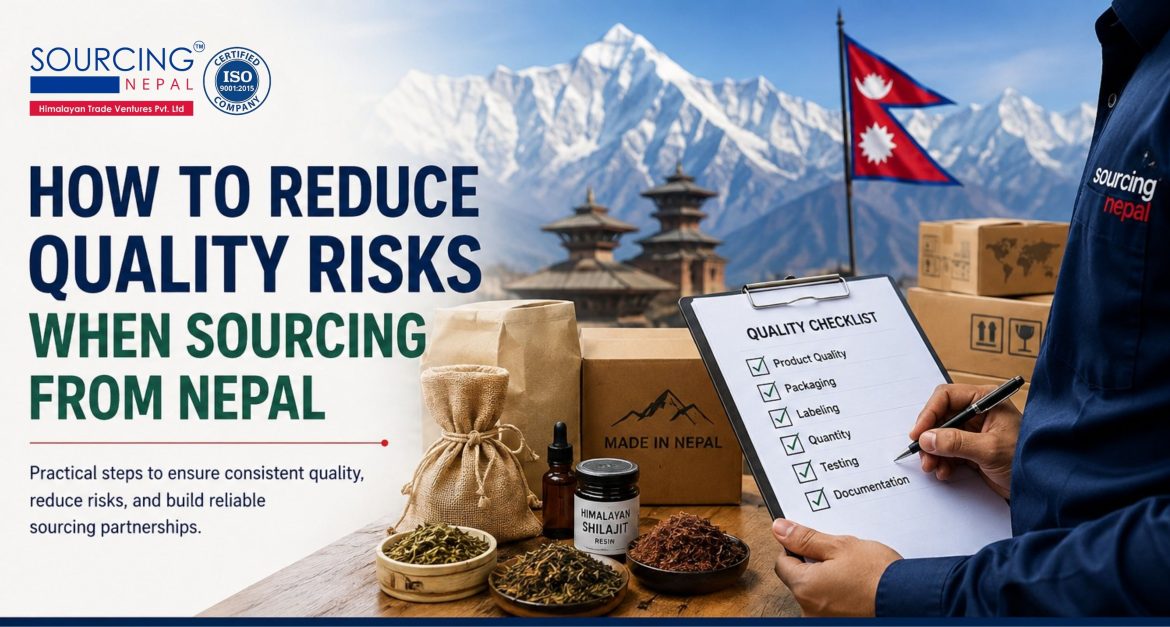
Quality Control Checklist for Buyers
Before approving an order from Nepal, ask yourself:
- Have I verified the supplier?
- Are my product specifications clearly documented?
- Have I approved a physical sample?
- Is the approved sample being used as the production benchmark?
- Does the supplier have sufficient production capacity?
- Are laboratory tests required?
- Have I confirmed destination-country requirements?
- Have packaging and labels been approved?
- Will the finished goods be inspected before shipment?
- Have all shipping documents been reviewed?
If the answer to these questions is yes, your sourcing process is significantly better prepared to manage quality risks.
Conclusion
Successful sourcing from Nepal requires more than finding a good product and negotiating a competitive price.
International buyers should build quality control into every stage of the purchasing process—from supplier verification and sample approval to testing, production monitoring, and pre-shipment inspection.
A structured quality-control process can reduce costly mistakes, improve supplier accountability, and help international buyers build long-term sourcing relationships in Nepal.
For businesses looking to source Himalayan products, herbs, spices, essential oils, handicrafts, food products, pet products, and other Nepali goods, having a reliable local sourcing partner can make the process significantly easier.
Looking to source from Nepal?
Sourcing Nepal can help you identify suppliers, verify manufacturers, coordinate samples, inspect production, arrange testing, and manage the sourcing process from Nepal to your destination market.
📩 Ready to import from Nepal?
Contact us today for samples, pricing, or consultation:
🔗 www.sourcingnepal.com
📧 sourcing@sourcingnepal.com
📞 +977-9823900499