
Nepal’s Landlocked Geography & Export Logistics
Nepal offers international buyers access to products that are difficult to find elsewhere, including Himalayan herbs, spices, essential oils, handicrafts, textiles, natural products, tea, coffee, and specialty food products.
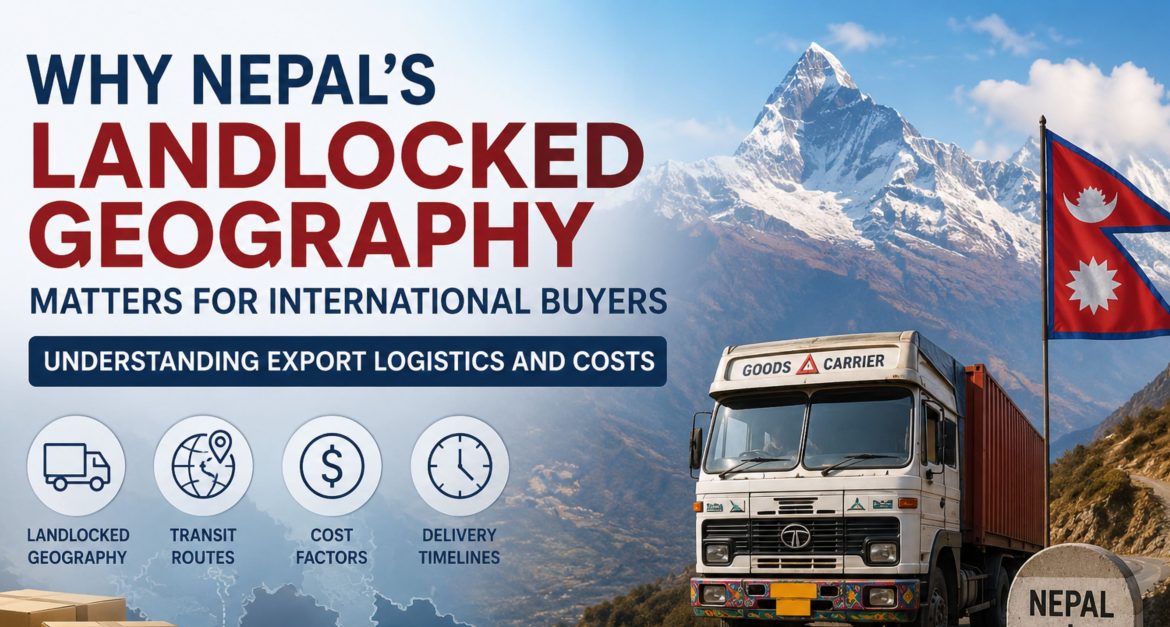
But for businesses sourcing from Nepal, there is one important logistical reality that should be understood from the beginning: Nepal is a landlocked country.
Unlike countries with direct access to a seaport, Nepal relies on transit routes through neighboring countries to connect its exports with international shipping networks. This does not prevent Nepal from exporting globally, but it does add additional stages to the logistics chain that buyers should consider when calculating costs and delivery timelines.
Understanding this structure can help international buyers plan more accurately and avoid unexpected logistics expenses.
What Does Being Landlocked Mean for Nepal’s Exports?
Nepal does not have its own coastline or seaport. Export cargo destined for overseas markets therefore has to travel by land before reaching an international seaport or another international transport connection.
For third-country trade, India is a major transit route. Nepal and India have established transit arrangements that allow Nepalese cargo to move through Indian territory toward seaports and international destinations. Nepal’s Trade and Export Promotion Centre (TEPC) describes these arrangements as necessary to provide Nepal, as a landlocked country, access to the sea for international trade.
For an international buyer, this means that a shipment from Nepal may involve more than simply booking a truck from a factory to a port.
The logistics chain can include:
Supplier → Nepal Customs → Border Transit → Indian Transit Network → Seaport → Ocean Freight → Destination Port → Final Delivery
Each stage needs to be coordinated properly.
Why Transit Matters When Sourcing from Nepal
A product may be manufactured or collected in Kathmandu, Pokhara, Biratnagar, or another part of Nepal, but its international journey can extend far beyond Nepal’s borders.
Nepal’s export procedures provide for cargo to move through Indian customs and transit systems before reaching international shipping points. TEPC’s export procedure, for example, outlines documentation and customs processes for Nepalese exports moving through India.
This makes transit planning an important part of the sourcing process.
For buyers, the key point is simple: the factory price is not the same as the landed cost.
The Costs Buyers Need to Consider
When evaluating a supplier quotation, international buyers should look beyond the product’s unit price.
The final logistics cost can include several components.
1. Inland Transportation
The first transportation leg moves the goods from the supplier or production facility to the relevant customs or border point.
The cost depends on:
- Distance
- Shipment volume
- Weight
- Type of cargo
- Packaging
- Vehicle requirements
- Pickup location
A supplier located outside the main commercial centers may have different transportation costs from a supplier based in Kathmandu.
2. Customs and Documentation
Export shipments require proper documentation and customs processing.
Depending on the product and destination, documentation can include commercial invoices, packing lists, certificates of origin, payment-related documents, and product-specific certificates.
Nepal’s export procedure also specifies documentation requirements for shipments moving through India, including customs transit documentation and commercial documents.
Documentation itself may not always represent the largest cost, but incorrect or incomplete paperwork can create much more expensive problems through delays and additional handling.
3. Transit and Handling Charges
Because Nepalese cargo has to move through a transit country, additional logistics services may be involved.
These can include:
- Transit handling
- Clearing and forwarding
- Warehousing
- Container-related services
- Cargo consolidation
- Border handling
- Transit documentation
- Nepal Transit and Warehousing Company Limited (NTWCL), a government-owned enterprise, provides transit-related services for Nepal’s overseas trade, including warehousing, cargo-related services, and transit operations.
4. Port and Ocean Freight
Once the cargo reaches an international seaport, it enters the conventional international shipping network.
At this point, buyers may encounter costs such as:
- Port handling
- Container charges
- Ocean freight
- Documentation fees
- Insurance
- Destination charges
These costs are separate from the original Nepal supplier price.
For this reason, buyers should request a clear quotation that distinguishes the product cost from transportation and other logistics charges.
Does Being Landlocked Make Nepal Uncompetitive?
Not necessarily.
This is an important distinction.
Nepal’s landlocked geography can make logistics more complex, but product competitiveness is determined by more than transportation costs.
Nepal has access to distinctive raw materials, traditional production knowledge, skilled artisans, agricultural products, and Himalayan-origin products that can offer significant value in international markets.
For example, a buyer sourcing a unique Himalayan ingredient may be willing to accept a more complex logistics route because the product itself offers characteristics that are difficult to replicate elsewhere.
The right question is therefore not simply:
“Is shipping from Nepal expensive?”
It is:
“Does the total landed cost make sense for the product, quality, and market?”
Why Consolidation Can Help
For smaller international buyers, shipping a small quantity from Nepal can sometimes make the logistics cost per unit relatively high.
Consolidation can help address this.
Multiple products or orders may be combined into a more efficient shipment where practical, reducing the logistics burden on individual products.
For example, instead of arranging separate transportation for several small orders, a sourcing partner may coordinate production schedules, packaging, consolidation, and shipment planning.
This can be particularly useful for buyers testing several Nepali products before committing to larger volumes.
Delivery Time Should Be Planned From the Beginning
Another important consideration is timing.
International buyers should not calculate delivery time based only on how long production takes.
A supplier may need several weeks to manufacture or prepare the goods, followed by inland transportation, customs processing, transit movement, port handling, and international shipping.
Therefore, buyers should discuss the complete supply-chain timeline before confirming an order.
Building some buffer into the schedule is especially important for event merchandise, seasonal products, promotional campaigns, and time-sensitive retail launches.
The Advantage of Working With a Local Sourcing Partner
The complexity of Nepal’s logistics system is one reason international buyers may benefit from working with a local sourcing company.
A local partner can coordinate with suppliers, check production progress, arrange quality inspections, prepare documentation, and communicate with logistics providers.
Instead of managing every stage remotely, buyers have a local point of contact who can identify problems before they become expensive delays.
This is particularly valuable for first-time buyers sourcing from Nepal.
How Sourcing Nepal Helps International Buyers
At Sourcing Nepal, we help international businesses manage the sourcing process from supplier identification through production and export logistics.
Our support can include supplier sourcing, supplier verification, product sampling, quality control, laboratory testing coordination, packaging, documentation support, and shipment coordination.
The goal is not simply to find a supplier. It is to help buyers understand the complete process and build a sourcing arrangement that works commercially.
Frequently Asked Questions About Sourcing from Nepal
What does MOQ mean?
Why do suppliers have an MOQ?
Is the MOQ the same for every product in Nepal?
Does a lower MOQ mean a higher price?
How can I find the right MOQ when sourcing from Nepal?
Final Thoughts
Nepal’s landlocked geography is an important factor for any international business considering sourcing from the country.
It means that exports require transit through established international routes and may involve additional transportation, handling, documentation, and coordination compared with sourcing directly from a coastal manufacturing country.
However, these challenges do not eliminate Nepal’s opportunities.
For buyers looking for distinctive Himalayan products, natural ingredients, handicrafts, agricultural products, and specialty goods, the value of sourcing from Nepal can outweigh the additional logistical complexity.
The key is to calculate the complete landed cost, plan the supply-chain timeline carefully, and work with experienced local partners who understand Nepal’s suppliers and export process.
When logistics are planned from the beginning, Nepal can remain a practical and valuable sourcing destination for international buyers.
📩 Ready to import from Nepal?
Contact us today for samples, pricing, or consultation:
🔗 www.sourcingnepal.com
📧 sourcing@sourcingnepal.com
📞 +977-9823900499