
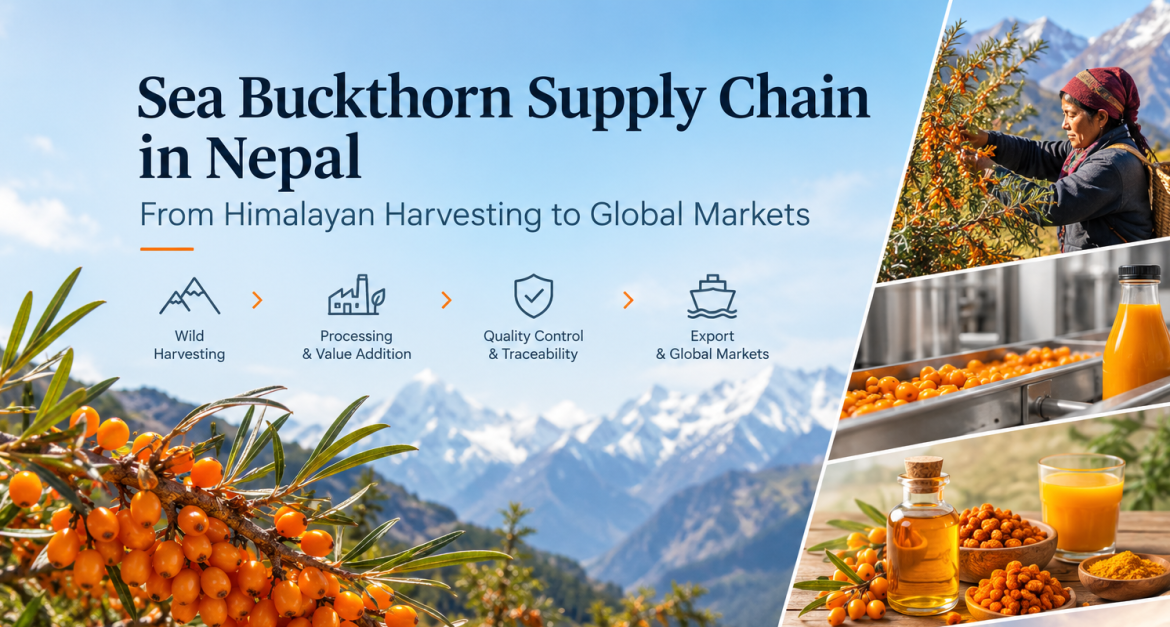
Sea Buckthorn Supply Chain in Nepal: From Wild Harvesting to International Markets
Sea buckthorn is emerging as one of Nepal’s promising Himalayan natural products, particularly for businesses looking for distinctive fruit ingredients, functional beverages, botanical oils, and other value-added products. Unlike conventional agricultural commodities, much of Nepal’s sea buckthorn supply is connected to high-altitude and wild-growing resources, making the supply chain highly dependent on local collectors, communities, processors, and regional infrastructure.
For international buyers, understanding this supply chain is essential. Sourcing sea buckthorn from Nepal is not simply about finding berries at a competitive price. Buyers need to consider harvesting practices, collection, processing, traceability, quality testing, documentation, packaging, and export logistics.
Where Sea Buckthorn Comes From in Nepal
Sea buckthorn grows naturally in several high-altitude Himalayan and trans-Himalayan areas of Nepal. Regions including Mustang, Manang, Dolpa, Humla, Mugu, Jumla and other mountain areas have been associated with sea buckthorn resources and local utilization.
Government and development studies have identified sea buckthorn as a potential value-chain product for Himalayan communities. Recent value-chain work has examined collection, processing, drying, oil extraction, juice production, marketing, and opportunities for domestic and international markets.
The geographical conditions of these areas make the supply chain different from conventional commercial fruit production. Remote collection locations, difficult terrain and seasonal harvesting windows can all influence availability, transportation and processing schedules.
For international buyers, this means that reliable sourcing requires local coordination rather than simply purchasing raw fruit from an online supplier.
1. Wild Harvesting and Responsible Collection
The sea buckthorn supply chain generally begins with harvesting berries from naturally occurring plants or managed resources.
Local collectors play an important role because they understand the harvesting locations, seasonal conditions and traditional collection practices. However, commercial demand must be balanced with responsible resource management.
Overharvesting can damage plants and reduce future availability. Sustainable collection therefore needs to consider harvesting techniques, collection quantities, regeneration and the condition of local resources.
For buyers developing long-term supply chains, traceability should ideally extend back to the collection area or community whenever practical.
This can help answer important questions such as:
- Where was the sea buckthorn collected?
- When was it harvested?
- Who collected it?
- Was the material wild-collected or cultivated?
- How was it transported after harvesting?
- What processing facility handled the raw material?
A transparent supply chain provides greater confidence to international buyers and can also support responsible sourcing programs.
2. Collection and Transportation to Processing Facilities
After harvesting, berries need to move from remote Himalayan collection areas to collection points and processing facilities.
This stage can be one of the most challenging parts of sourcing sea buckthorn from Nepal. Mountain roads, transportation distances and seasonal accessibility can affect how quickly raw material reaches processors.
Post-harvest handling is therefore important.
Depending on the final product, processors may need to sort, clean, preserve, freeze, dry or otherwise stabilize the raw material before further processing.
The objective is to protect the quality of the fruit while minimizing contamination, physical damage and unnecessary delays.
For international buyers, it is useful to understand not only the final product specification but also what happens between harvesting and processing.
3. Processing Creates Greater Export Value
Selling raw berries is only one part of the opportunity. Much of the commercial potential comes from converting sea buckthorn into value-added products.
Products associated with Nepal’s developing sea buckthorn sector include:
- Sea buckthorn juice
- Pulp
- Oil
- Jam
- Powder
- Dried products
- Ingredients for food and wellness formulations
Recent development initiatives in Nepal have supported product diversification, including juice, jam and oil, alongside processing equipment, farmer training and market development.
Processing can make transportation and international distribution more practical while allowing businesses to target different markets.
For example, a beverage company may require juice or pulp, while a cosmetics manufacturer may be interested in sea buckthorn oil. A supplement or functional-food company may instead require powder or another standardized ingredient.
This makes product specifications particularly important when sourcing from Nepal.
4. Quality Control and Testing
Quality control should begin before the finished product is packed for export.
For sea buckthorn products, buyers may need to establish specifications covering characteristics such as:
- Appearance and colour
- Taste and aroma
- Moisture, where applicable
- Microbiological parameters
- Heavy metals
- Pesticide residues
- Nutritional or compositional parameters
- Packaging and shelf life
- Batch identification and traceability
The exact testing requirements depend on the product format and destination market.
A Certificate of Analysis (COA) can help buyers evaluate whether a particular batch meets agreed specifications. Where necessary, laboratory testing can also be arranged through appropriate testing facilities.
This is particularly important for international buyers because a product described as “natural,” “wild harvested,” or “Himalayan” should not automatically be assumed to meet a particular regulatory or quality standard.
5. Traceability Matters for International Buyers
Traceability is becoming increasingly important across global food, botanical and natural-product supply chains.
For sea buckthorn, a practical traceability system can connect the finished batch with information about its origin, collection, processing and packaging.
A buyer may request information such as:
Collection area → Collector/community → Raw-material lot → Processing facility → Production batch → Laboratory testing → Final packaging → Export shipment
Maintaining this chain of information can improve transparency and make it easier to investigate quality issues if they occur.
It can also help brands communicate a credible Himalayan origin story without making unsupported claims about sustainability, organic status or health benefits.
6. Preparing Sea Buckthorn for International Markets
Once the product has been processed and quality requirements have been confirmed, the next stage is export preparation.
International buyers should confirm:
- Product specifications
- Quantity and MOQ
- Packaging format
- Shelf life
- Label requirements
- Batch information
- Required laboratory reports
- Certificate of Origin, where applicable
- Phytosanitary or other product-specific documents, where required
- Commercial invoice
- Packing list
- Shipping method
- Destination-country import requirements
Nepal’s export procedures can vary depending on the nature of the product. For plant and forest-based products, additional permissions, release documentation or phytosanitary requirements may apply depending on the product form and destination.
Therefore, buyers should determine documentation requirements before production and shipment rather than waiting until the cargo is ready to leave Nepal.
7. Moving from Nepal to International Markets
Nepal’s landlocked geography means international shipments require careful logistics planning.
Sea buckthorn products can be exported through appropriate air or land-and-sea logistics depending on the product’s shelf life, volume, urgency and destination.
For commercial shipments, buyers and exporters need to consider:
- Product stability
- Packaging protection
- Transit time
- Freight cost
- Customs documentation
- Import-country requirements
- Shipment consolidation
- Insurance, where applicable
A sourcing partner with local knowledge can coordinate these steps between the processor, exporter, logistics provider and international buyer.
Why the Sea Buckthorn Supply Chain Has International Potential
The opportunity for Nepal is not limited to exporting raw Himalayan berries.
The greater potential lies in developing a stronger value chain that connects collectors and mountain communities with capable processors, quality-control systems and international buyers.
Nepal already has experience with local sea buckthorn juice production, while more recent initiatives have expanded attention toward oil, jam, processing technology, certification and international market access.
For international brands, this creates opportunities to source differentiated Himalayan ingredients while developing products for food, beverage, wellness and cosmetic markets.
However, long-term growth will depend on consistent quality, responsible harvesting, reliable processing, transparent documentation and dependable export coordination.
How Sourcing Nepal Supports Sea Buckthorn Buyers
For an international buyer, building a supply chain in Nepal can involve several different parties: collectors, processors, laboratories, packaging suppliers, exporters and logistics providers.
Sourcing Nepal helps simplify this process by connecting international buyers with suitable Nepali suppliers and coordinating the sourcing process locally.
Our support can include:
- Supplier identification and verification
- Sea buckthorn product sourcing
- Sample coordination
- Product specification coordination
- Quality-control support
- Laboratory testing coordination
- Pre-shipment inspection
- Packaging and labeling coordination
- Export documentation
- Shipment consolidation and logistics coordination
Our objective is to help buyers move from simply finding a Himalayan product to developing a more reliable and transparent supply chain.
Building a Reliable Himalayan Sea Buckthorn Supply Chain
Sea buckthorn has the potential to become an important value-added product within Nepal’s Himalayan natural-product sector.
The journey from wild harvesting to international markets involves much more than collecting berries. It requires responsible harvesting, careful post-harvest handling, efficient processing, quality testing, traceability, compliant documentation and reliable logistics.
For international buyers, these factors can make the difference between a one-time purchase and a sustainable long-term sourcing relationship.
As global interest in distinctive natural ingredients continues to grow, Nepal’s sea buckthorn supply chain presents an opportunity to connect Himalayan resources and communities with international food, beverage, wellness and natural-product markets.
If you are looking to source sea buckthorn juice, pulp, oil, powder or other sea buckthorn products from Nepal, working with a local sourcing partner can help simplify supplier coordination, quality control and export processes.
📩 Ready to import from Nepal?
Contact us today for samples, pricing, or consultation:
🔗 www.sourcingnepal.com
📧 sourcing@sourcingnepal.com
📞 +977-9823900499