
Understanding Nepal's Harvest Seasons: A Procurement Planning Guide for International Buyers
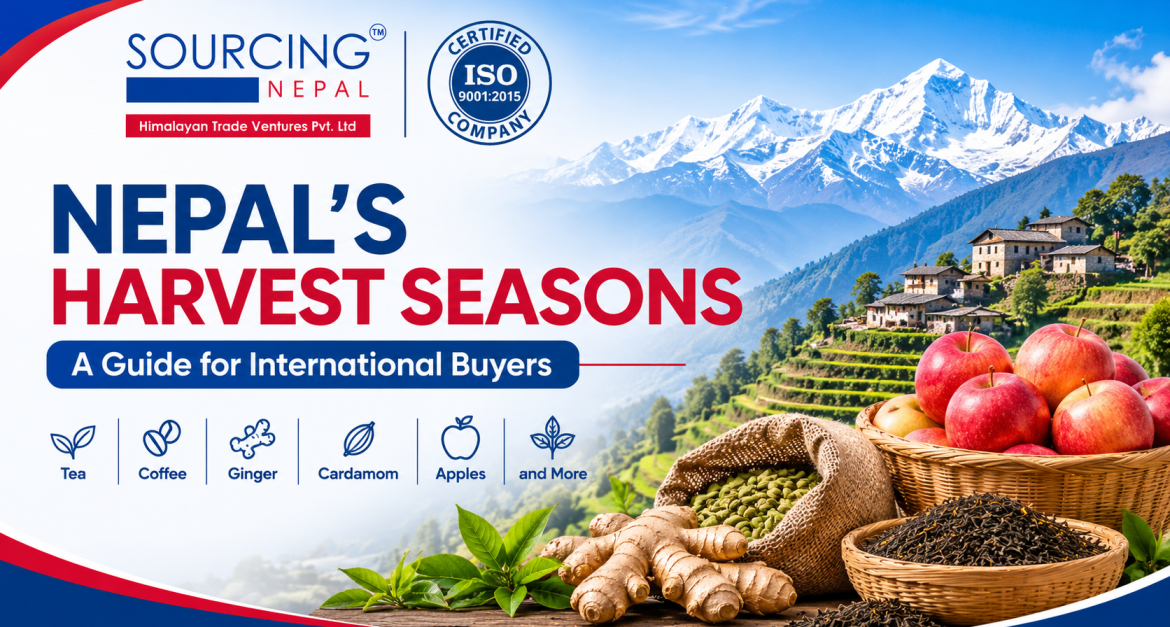
Nepal’s diverse geography, climate, and agricultural practices create opportunities for international businesses looking to source agricultural commodities, natural ingredients, and specialty products. From Himalayan herbs and spices to tea, coffee, fruits, and traditional food products, the country offers a variety of products with distinct production cycles.
However, sourcing agricultural products from Nepal requires more than identifying a supplier and agreeing on a price. Product availability, quality, processing capacity, and procurement costs can change throughout the year depending on harvesting periods and local growing conditions.
For international buyers, understanding these seasonal patterns can make a significant difference when planning bulk purchases, negotiating with suppliers, and arranging international shipments.
This guide explores Nepal’s agricultural seasons, the harvesting periods of selected products, and how businesses can plan their sourcing activities more effectively.
1. Why Harvest Seasons Matter When Sourcing from Nepal
Agricultural products are not always available in consistent quantities throughout the year. Many products have specific harvesting periods, while others can be processed and stored for supply beyond their original harvest season.
Understanding these differences helps international buyers make informed purchasing decisions.
Some important considerations include:
Product availability: Fresh agricultural products may only be available during specific months.
Pricing fluctuations: Seasonal supply and market demand can influence purchasing prices.
Product quality: Harvest maturity, weather conditions, and processing methods can affect product characteristics.
Processing capacity: Suppliers may experience increased workloads during peak harvesting periods.
Storage requirements: Products intended for year-round supply may require appropriate drying, storage, and preservation.
Procurement lead times: Buyers may need to coordinate purchases in advance to secure the required quantity.
For businesses purchasing agricultural ingredients in bulk, understanding the relationship between harvesting, processing, and availability is essential.
2. Understanding Nepal’s Agricultural Seasons
Nepal’s agricultural calendar is strongly influenced by the monsoon, winter conditions, and variations in altitude.
The country can broadly be divided into three geographical regions: the Terai plains, the mid-hills, and the Himalayan mountain region. Each has different climatic conditions and agricultural opportunities.
Spring Season (March–May)
Spring is an important period for agricultural activity in Nepal. Farmers prepare land, plant seasonal crops, and begin harvesting certain products.
This period is particularly relevant for early tea production, spring agricultural activities, and the beginning of various fruit and vegetable growing cycles.
Monsoon Season (June–September)
The monsoon brings substantial rainfall to many parts of Nepal and supports the cultivation of major agricultural crops.
Rice cultivation is particularly dependent on monsoon rainfall. Maize, vegetables, and other seasonal crops are also grown during this period.
However, heavy rainfall can create transportation challenges, affect drying operations, and increase the importance of proper post-harvest handling.
Autumn Season (October–November)
Autumn is one of the important harvesting periods in Nepal.
Several agricultural commodities become available during this time, including paddy, large cardamom, and various fruits and spices.
For international buyers, this period can offer opportunities to coordinate procurement of selected seasonal products.
Winter Season (December–February)
Winter is an important period for harvesting and processing certain agricultural products, including ginger and coffee.
In higher-altitude regions, agricultural activity becomes more limited because of colder temperatures. However, products harvested earlier may remain available through established storage and processing facilities.
3. Harvest Seasons of Major Nepali Products
The following calendar provides an indicative overview of selected products and their typical harvesting periods. Actual availability depends on location, variety, altitude, and annual weather conditions.
| Product | Indicative harvesting period | Important sourcing considerations |
|---|---|---|
| Orthodox Tea | March–November (seasonal flushes) | Flush, grade, aroma and processing |
| Coffee | November–January | Cherry maturity, picking and processing |
| Ginger | November–January | Maturity, cleaning, drying and storage |
| Large Cardamom | September–November | Capsule maturity, drying and grading |
| Apples | August–December | Variety, maturity, grading and storage |
| Paddy (Rice) | October–December | Variety, moisture and milling |
| Maize | July–September (main season) | Moisture, drying and storage |
These periods are planning references rather than guaranteed supply dates.
4. How Seasonal Changes Affect Pricing and Product Quality
Seasonality can influence both the commercial and technical aspects of agricultural sourcing.
When harvesting begins, larger quantities of certain products may enter local markets. However, this does not automatically mean that every product will be cheaper during its harvest period.
Several factors influence pricing:
Production volume: Weather conditions, crop performance, and cultivated area can affect the total quantity available.
Market demand: Domestic consumption and international demand can influence local purchasing prices.
Processing costs: Drying, cleaning, grading, packaging, and storage contribute to the final product cost.
Transportation: Road conditions and transportation distances can influence the cost of moving products from farming regions to processing facilities and export points.
Quality also requires attention. For example, the quality of dried agricultural products depends on appropriate harvesting maturity, drying methods, moisture management, and storage conditions.
Therefore, buyers should evaluate product specifications and actual supplier quotations rather than assuming that seasonal procurement will always provide the lowest price.
5. When Should International Buyers Place Their Orders?
For international buyers, the best time to begin procurement discussions is often before the expected harvesting period.
Early communication gives suppliers and sourcing partners more time to assess availability, estimate quantities, arrange samples, and coordinate production.
A practical procurement approach can follow these stages:
Stage 1: Define product requirements
Establish the required product, grade, specifications, quantity, packaging, and destination-market requirements.
Stage 2: Identify the harvesting window
Understand the expected harvesting period for the selected product and its major production regions.
Stage 3: Contact and evaluate suppliers
Discuss production capacity, expected availability, pricing, processing facilities, and documentation.
Stage 4: Arrange samples
Evaluate samples against the agreed specifications before confirming a commercial order.
Stage 5: Confirm procurement and processing
Coordinate the purchasing schedule, processing requirements, packaging, and quality checks.
Stage 6: Arrange export logistics
Prepare the required documentation, shipment arrangements, and final inspection before dispatch.
This approach helps buyers plan purchases around actual production cycles instead of making last-minute sourcing decisions.
6. Year-Round Supply: Can Seasonal Products Be Sourced Throughout the Year?
Not every product needs to be purchased immediately after harvesting.
Some agricultural products can be dried, processed, stored, or converted into value-added ingredients, making them available beyond their original harvesting periods.
For example:
- Fresh ginger can be processed into dried slices or powder.
- Coffee cherries can be processed into green coffee beans for storage and export.
- Tea can be processed, graded, packed, and stored according to its specific requirements.
- Apples can be converted into dried fruit products.
- Large cardamom can be dried and stored under appropriate conditions.
However, extended availability depends on product stability, processing standards, packaging, storage conditions, and supplier inventory.
Buyers should always confirm whether a supplier is offering newly harvested material, previously processed inventory, or stored stock.
For products sensitive to moisture, aroma, or oxidation, appropriate storage and packaging are especially important.
7. How Sourcing Nepal Supports Seasonal Procurement
Coordinating agricultural procurement from another country can involve multiple suppliers, farming regions, processors, testing facilities, and logistics providers.
Sourcing Nepal supports international businesses by connecting them with suitable Nepali suppliers and coordinating different stages of the sourcing process.
Our services include:
- Supplier identification and verification
- Product sourcing and supplier coordination
- Bulk pricing and availability discussions
- Sample sourcing and development coordination
- Quality control and pre-shipment inspection
- Laboratory testing coordination
- Export documentation support
- Shipment consolidation and logistics coordination
For seasonal products, early procurement discussions can help buyers understand expected availability, sourcing timelines, and supplier capabilities before making purchasing commitments.
Whether you are sourcing Himalayan natural ingredients, agricultural commodities, specialty tea, coffee, spices, or other Nepali products, our team can help coordinate your sourcing requirements.
Conclusion
Understanding Nepal’s harvest seasons is an important part of building a reliable agricultural sourcing strategy.
Different products follow different production cycles, and their availability depends on geographical conditions, altitude, weather, processing capacity, and market demand.
For international buyers, planning procurement ahead of harvesting periods can provide more time for supplier evaluation, sample approval, quality requirements, and export arrangements.
Rather than approaching sourcing as a one-time purchasing activity, businesses should consider seasonal planning as part of their long-term supply strategy.
Planning to source agricultural or natural products from Nepal?
Sourcing Nepal helps international buyers connect with local suppliers and coordinate product sourcing, quality control, export documentation, and shipment arrangements.
Why the Sea Buckthorn Supply Chain Has International Potential
The opportunity for Nepal is not limited to exporting raw Himalayan berries.
The greater potential lies in developing a stronger value chain that connects collectors and mountain communities with capable processors, quality-control systems and international buyers.
Nepal already has experience with local sea buckthorn juice production, while more recent initiatives have expanded attention toward oil, jam, processing technology, certification and international market access.
For international brands, this creates opportunities to source differentiated Himalayan ingredients while developing products for food, beverage, wellness and cosmetic markets.
However, long-term growth will depend on consistent quality, responsible harvesting, reliable processing, transparent documentation and dependable export coordination.
📩 Ready to import from Nepal?
Contact us today for samples, pricing, or consultation:
🔗 www.sourcingnepal.com
📧 sourcing@sourcingnepal.com
📞 +977-9823900499